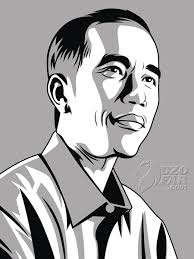
joko Widodo, popularly known as Jokowi, is a classic rags-to-riches
tale. Born in Solo (Surakarta), Central Java, in 1961, he was the oldest
child of a family of four and the only son. His father was a struggling
small-time timber collector. The family lived in flimsy run-down rented
shacks on the flood-prone banks of a river. Nevertheless, his family
assisted him through school and he eventually graduated with a degree in
forestry from Gadjah Mada University in Jogjakarta, in 1986.
Jokowi joined the forestry service of a state enterprise in Aceh
before returning to Solo in 1989 to work with his uncle and learn the
furniture business from design to delivery. Then he branched out on his
own. He was the beneficiary of a small loan from his father and later a
government business sponsorship scheme, and soon established a thriving
furniture business with a strong export focus. In a searing experience
in 1990, one customer in Jakarta refused to pay for a large order,
almost bankrupting him. By severely cutting back his business and with
determination, however, he endured and soon rebounded.
He established
a strong overseas market for his products. At one point he had over
1000 people working for him in multiple locations. His entrepreneurial
flair was recognised by business associates who nominated him to head a
newly established branch of the furniture manufacturers association in
2002. His success in this role prompted his colleagues to press him to
run for mayor of Solo, one of the historic cities of Central Java. He
won the 2005 mayoral election under the banner of Megawati
Sukarnoputri’s Indonesian Democratic Party of Struggle (PDIP). He won a
second term in 2010.
His strategy was to revive Solo through preserving and promoting its
historic attributes without discouraging modernisation. Rather than
sending out municipal police to clear street traders blocking traffic,
he engaged them in lengthy discussions and created safe and accessible
places where they could improve their trade. Walkways and historic modes
of transport were revitalised or built to encourage people back onto
the streets of the city. Zoning laws were enforced to prevent the
‘mallisation’ of the historic core of the town. His success was such
that mid-term he was nominated by PDIP to run for governor of Jakarta.
He succeeded in ousting the favoured incumbent in the 2012 elections. In
a sign of his political acumen, he went to great lengths to explain his
reasons for leaving to the people of Solo and convey his confidence
that they would preserve and continue the city’s progress.
Leading through example
The memoir shows Jokowi to be a politically astute, compassionate
conservative who believes that the role of government is to unleash the
genius of the people, not mollycoddle them. He has a hands-on style of
leadership and seeks to give hope to the poor by engaging them directly
and giving them access to education, health care and basic services. As a
businessman and reform-oriented politician he has a visceral hatred of
corruption and the labyrinthine bureaucracy in which it thrives. He
gives his bureaucrats little quarter. He does not claim to have the
answers to all of Indonesia’s problems, but he passionately believes
that humans can produce the answers to human-made problems. He is ready
to draw on the expertise and experience of those who can help solve the
problems he confronts. He has recently held extensive discussions with
the Singaporeans, for example, on how to manage the construction of a
MRT in Jakarta. Work on the project has already begun.
Jokowi currently claims to have no ambitions beyond fixing the long
neglected infrastructure problems of Jakarta and improving the lot of
its poor. However, any reading of the book leaves no doubt that he is
willing to be a contender if called. Marcus Meitzner, a leading
Indonesian scholar at ANU, has already called the election in his
favour. The polls also seem to indicate that he would win a presidential
election. In some recent polls, Jokowi has doubled the percentages of
his nearest rivals.
Preparations are underway for the presidential elections this year.
Jokowi can likely afford to stand back until the parliamentary elections
in April-May, which will determine the parties entitled to run a
candidate in the presidential election. However, he may be called
earlier, as any party hoping to nominate him will want to draw on his
popularity in the parliamentary elections. The obvious party to nominate
him is PDIP. However, party chairwoman Megawati, responsible for
nominating PDIP’s presidential candidate, is thought to still harbour
hopes of running herself, even though polls indicate that this would be
disastrous for her party.
Brand ‘Jokowi’
Jokowi is not a great or inspiring public speaker, but he is a master
of symbolism and ‘branding’. Nothing is left to chance, be it dress,
mode of transport or unannounced inspections and visits. He understands
that he is an outsider, and that he must strengthen his robust social
base outside but not independently of the prominent political parties.
As the leader of a new breed of Indonesian politicians, he is a media
darling. His consultative, no-nonsense and hands-on leadership style has
endeared him to a people crying out for an end to ineffective and
corrupt government, which has been unable to address the challenges of
an economically thriving but politically stunted country. The current
president has brought stability, but fundamental reform has stalled
under his overly cautious leadership and a fractious and compromised
parliament.
So if he is called, agrees to run, and wins, what sort of president
would Jokowi make? First and foremost, he brings very little political
baggage. His personal wealth has insulated him from the taint of money
politics and cronyism. He is not driven by ideology and is a pragmatic,
astute problem solver with a deep commitment to reform. For example, he
is making the Jakarta provincial budget and associated expenditure
public. He demands that merit be a major consideration in the selection
of public officials.
The same would probably be true for foreign and defence policy,
despite his lack of experience in these fields. There is unlikely to be
any fundamental changes in Indonesia’s non-aligned independent foreign
policy, in which, in the words of President Yudhoyono, it seeks ‘a
million friends and no enemies’. Nevertheless, he would likely be more
pragmatic and focus on those relationships and activities that would
contribute most to enhancing Indonesia’s domestic modernisation, reform
and security.
He would, however, have to operate in a much more complex, fragmented
and challenging political environment than he currently faces or has
previously experienced. Despite his personal integrity, he will be
pounded by the political and economic interests of the parties that
support him. He will also face the strong protectionist and nationalist
sentiments that confound seeking sensible solutions to seemingly simple
problems, such as scrapping government fuel subsidies or redrawing the
maritime boundary between East Kalimantan and Malaysia.
The book is carefully crafted and produced. It outlines his early
life and family struggles, and his challenges, trials and tribulations
as a businessman and politician. It is well written and reminds this
reviewer of Obama’s Dreams of My Father. The photos of Jokowi
bear at least a passing resemblance to Obama, especially where he is
dressed in an open necked white long-sleeved shirt.
The book has a simple but striking cover starring a casually dressed
and relaxed-looking Jokowi. It ends with a full range of photos showing
him in a cross-section of social settings. This is in stark contrast to
the expensive and vacuous hagiographies of New Order era and more recent
leaders.
Whether his fate is to become president or remain governor of
Jakarta, Jokowi will be more than a footnote in Indonesian history.
0 komentar:
Posting Komentar